
Understanding Biofilm Formation: Online Powertalk by University of Dundee, UK at i3L University
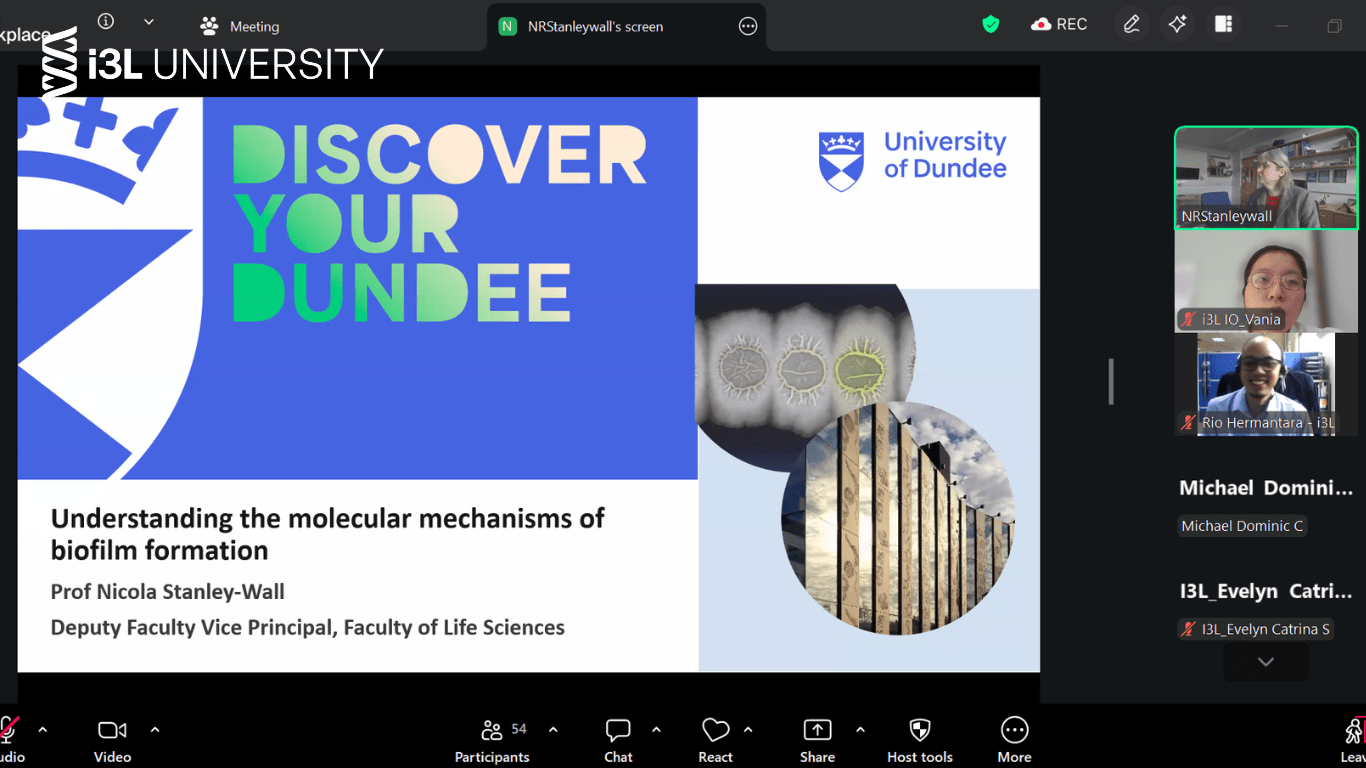
Jakarta, 06 May 2026 – i3L University recently held an online powertalk on Tuesday, 28th April 2026, featuring Prof. Nicola Stanley-Wall from the University of Dundee, moderated by Rio Hermantara, S.Si., M.Biotech, Ph.D, the dean of i3L School of Health and Life Sciences (SHLS). In this session, the presenter discussed how biofilms form at the molecular level. Students were able to join the session online and learn more about this important topic in microbiology.
During the powertalk, biofilms were explained as communities of bacteria that live and work together. Instead of acting as single cells, the bacteria cooperate and form structured groups. These groups have useful properties like strong attachment, protection, and the ability to share resources and information. Because of this, biofilms are more resistant and adaptable compared to individual bacteria.
The presenter focused on Bacillus subtilis, a type of bacteria often used in research. It is a Gram-positive bacterium that lives in soil and is also used in many industrial applications. In biofilms, B. subtilis shows a “division of labor,” where different groups of cells take on different roles. Together, they produce a matrix that acts like both a protective layer and a structure that holds the biofilm together. Other than that, three common ways to study its biofilm formation were introduced: pellicle formation (on liquid surfaces), colony formation (on solid media), and interaction with plant roots.
It was also explained how biofilms develop over time. Within about 48 hours, the biofilm grows outward and forms complex structures. A molecule called pulcherrimin plays a role in controlling growth by limiting iron availability around the biofilm. When iron levels are low, growth slows down but adding more iron can reverse this effect. It was also mentioned that in natural environments, Bacillus subtilis usually interacts with other organisms rather than living alone.
Another important part of the powertalk was about a protein called BsIA. This protein forms a protective coating around the biofilm and helps make it water-repellent (hydrophobic). This property helps protect the bacteria from harmful chemicals. BsIA can also change its structure depending on the environment, which helps maintain the biofilm’s stability.
Overall, the session helped students understand how biofilms form and function at a molecular level. It also showed how studying bacteria like Bacillus subtilis can be useful in areas such as agriculture, biomedicine, biotechnology, and environmental science. Through powertalks like this, students can gain insight into current studies and how scientific knowledge is developed.