
Rerasa: From Overlooked Vegetables to Sustainable Flavor
Written by: Abram Christya
Food waste is often associated with leftovers on our plates or food that is thrown away after consumption. Yet, the story begins much earlier. Along the food supply chain, from harvesting and distribution to processing and retail, large amounts of food can be left out before they even reach consumers. Some produce is rejected because its shape, size, color, or appearance does not meet market specifications. Other parts are discarded simply because they are not conventionally recognized as edible or useful.
Garlic skins, for example, are more often seen as something that should simply be peeled away and thrown out. The same can happen to vegetable roots, outer leaves, or parts of plants that are less commonly used in everyday cooking. In these cases, the issue is not necessarily the quality of the ingredient. Sometimes, what causes a part of a food ingredient to be overlooked is our habits, perceptions, or the way we have learned to define what is worth eating.
So, what if these ingredients were not only seen as leftovers, but as resources that still hold value?
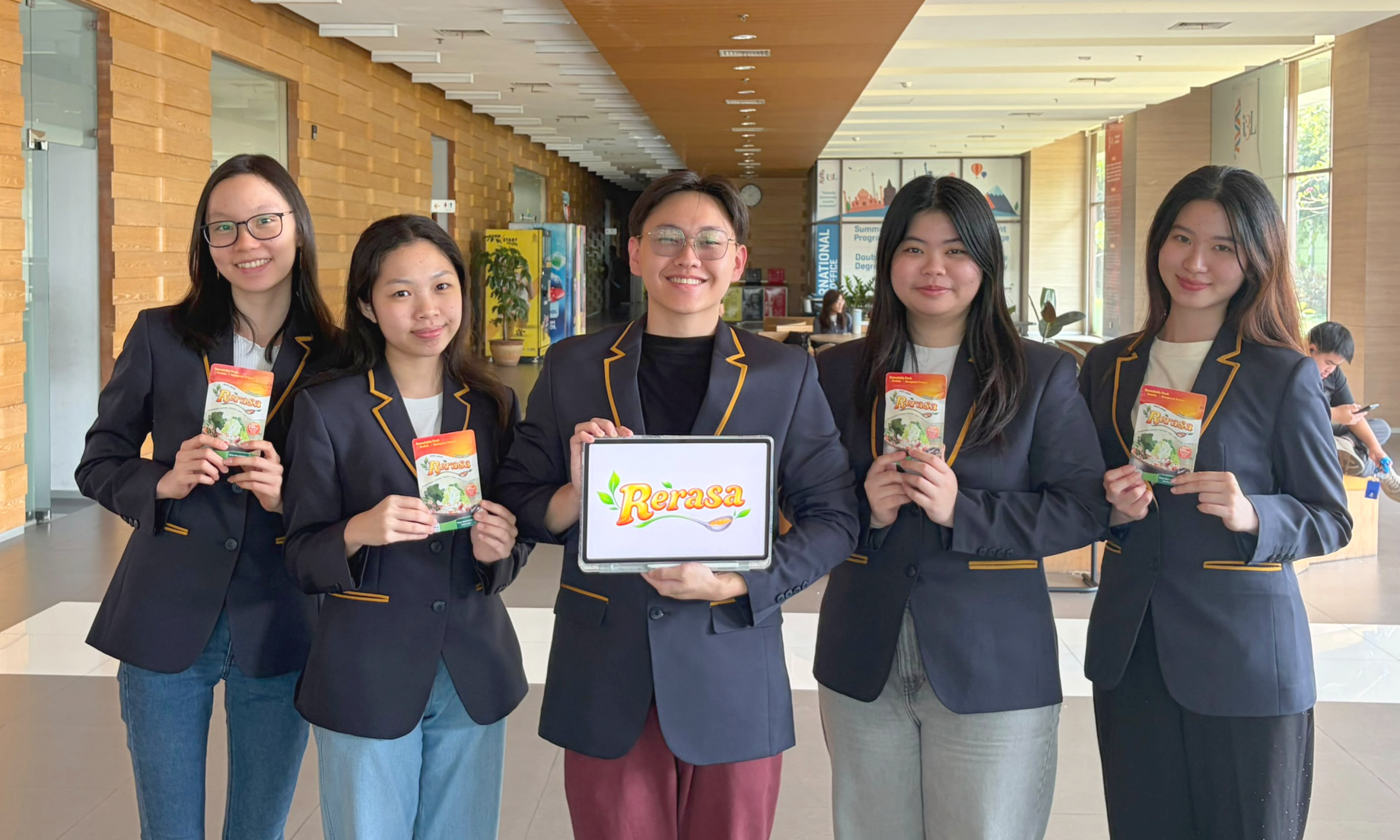
This question became one of the starting points for Rerasa, a food innovation created by five Food Technology students at i3L University through the 2026 Student Creativity Program for Entrepreneurship (PKM-K).
Food waste can occur at almost every stage of the food chain. During harvesting and distribution, vegetables may be left behind because they do not fit the visual or size requirements of particular markets. A cabbage that is smaller than usual, has torn outer leaves, or has a less desirable appearance may be considered unsuitable for sale, even though the edible portions can still retain nutritional value and culinary potential.
These are often referred to as imperfect vegetables—produce that may not meet conventional market standards in terms of appearance, shape, or size, but is not necessarily inferior in terms of its potential as a food ingredient. When appearance becomes an important parameter of value, vegetables that differ from the expected standard can quickly become waste.
The same pattern can occur even after an ingredient has entered the kitchen.
Consider garlic skins. For many people, the skin is simply something to be peeled away and discarded before the garlic is used. Cleaned roots are also often excluded from food preparation, while darker green spring onion leaves may be considered too old to use.
But does something become useless because it truly cannot be used—or because we have simply never considered using it?
The way we utilize food ingredients is often shaped by habit.
We become accustomed to using certain parts of an ingredient and discarding the rest. Over time, these habits can feel so normal that we rarely stop to question them.
Yet, our approach to food ingredients can change when food processing technology creates new possibilities. Parts that were previously unpopular for consumption can be processed, combined, or given a different function.
This idea was translated into action by five Food Technology students at i3L University. Under the supervision of Dr. oec. troph. Hanny Angrainy, B.Sc., MA, M.Sc., Annette Felicia Sutanto as team leader, together with Evan Manuel Wijaya, Feryna Tjandra Wijaya, Jessicca Vimala Yoe, and Hillary Clarence Rosli, created Rerasa, an innovative stock seasoning in sheet form, designed to provide savory flavor to everyday dishes.
The product specifically explores the use of imperfect vegetables, particularly imperfect Chinese cabbage and green cabbage, alongside garlic skins, as alternative raw materials for a value-added food product.
Its sheet format also offers an alternative to conventional powdered or cube-shaped stock. Through dehydration and formulation, the vegetable-based ingredients are transformed into a convenient seasoning that can be incorporated into everyday cooking.
What makes the product interesting is not only its format, but also how Rerasa attempts to change the way underutilized food ingredients can gain new value.
Ingredients that may have previously been considered merely the result of sorting or as parts that are not normally used can enter the processing stage and become part of a food product with a clear function. With this approach, Rerasa is not simply asking, “What can we make from the ingredients that are left over?”
The question goes further: “How can something that has long been overlooked regain its function?”
This is where the issue becomes even more interesting. Turning imperfect or underutilized ingredients into a new product may sound promising, but the food industry does not stop at asking whether a product can be made. A product must also respond to market needs. Consumers who are already accustomed to powdered or cube-shaped stock may ask: “Why should I try a different format?”
Convenience alone may not be enough to change established habits. This is where Rerasa aims to offer value beyond its format. The team positions Rerasa around taste, convenience, natural ingredients, and the utilization of underused food resources, while promoting it as a product that is MSG-free and nutritious according to its product concept.
The team has also been communicating these values through its Instagram platform, @rerasa.co, to introduce the product and its sustainability message to potential consumers. This is where food innovation and entrepreneurship work together.
Reducing food waste is not simply about throwing away less. There is a bigger question: what can be done before an ingredient becomes completely underutilized?
At the agricultural, distribution, market, and food industry levels, some ingredients may be left out for various reasons. Some do not meet certain specifications, some are less desirable, while others have simply never been considered conventional parts of the food we consume. Food technology can serve as a bridge for exploring alternative ways to utilize them.
Through processes such as dehydration, Rerasa transforms ingredients into a dried form that can be used as a seasoning product. The process is not merely about making the ingredients more shelf-stable or convenient, but also about transforming underutilized ingredients into products with new functions. At this point, food waste, food innovation, and entrepreneurship come together.
When an ingredient that was previously underutilized can be processed into a product that consumers need, the value created is not only nutritional or culinary, but also economic.
Of course, Rerasa cannot solve the issue of food waste on its own. Turning underutilized ingredients into a product also requires formulation, processing, testing, flavor consistency, and consumer acceptance. But that is precisely where the value of student innovation can be seen.
Rerasa demonstrates that food-related challenges can be viewed from a different perspective. Imperfect vegetables and garlic skins do not necessarily have to be worthless and discarded.
Sometimes, the problem is not with the ingredient itself. Maybe we simply have not found the right way to use it yet.
Through Rerasa, five i3L University students are giving a second chance to food ingredients that are often overlooked and showing that food innovation can begin with something we have long taken for granted.
“Bringing back the goodness of vegetables that are often overlooked.”

The Food Technology program at i3L aims to fulfil the needs of the society for sustainable food quality, safety, and security. This field applies the principles of science to ensure safe manufacture, packaging, and distribution. Students will complete a rigorous scientific curriculum that balances classroom lectures with practical sessions in our state-of-the-art laboratories. The Food Innovation Centre allows students to have trainings in our modern, on-campus food processing facilities, in which we strongly encourage our students to create innovative food products.
At i3L, we have broad industry networks and links to leading research organizations around the world to support students in finding suitable internships that can help them pave the way to their dream career in the food industry.