
Navigating Indonesia’s Industrial Water Future: Insights from i3L’s Webinar
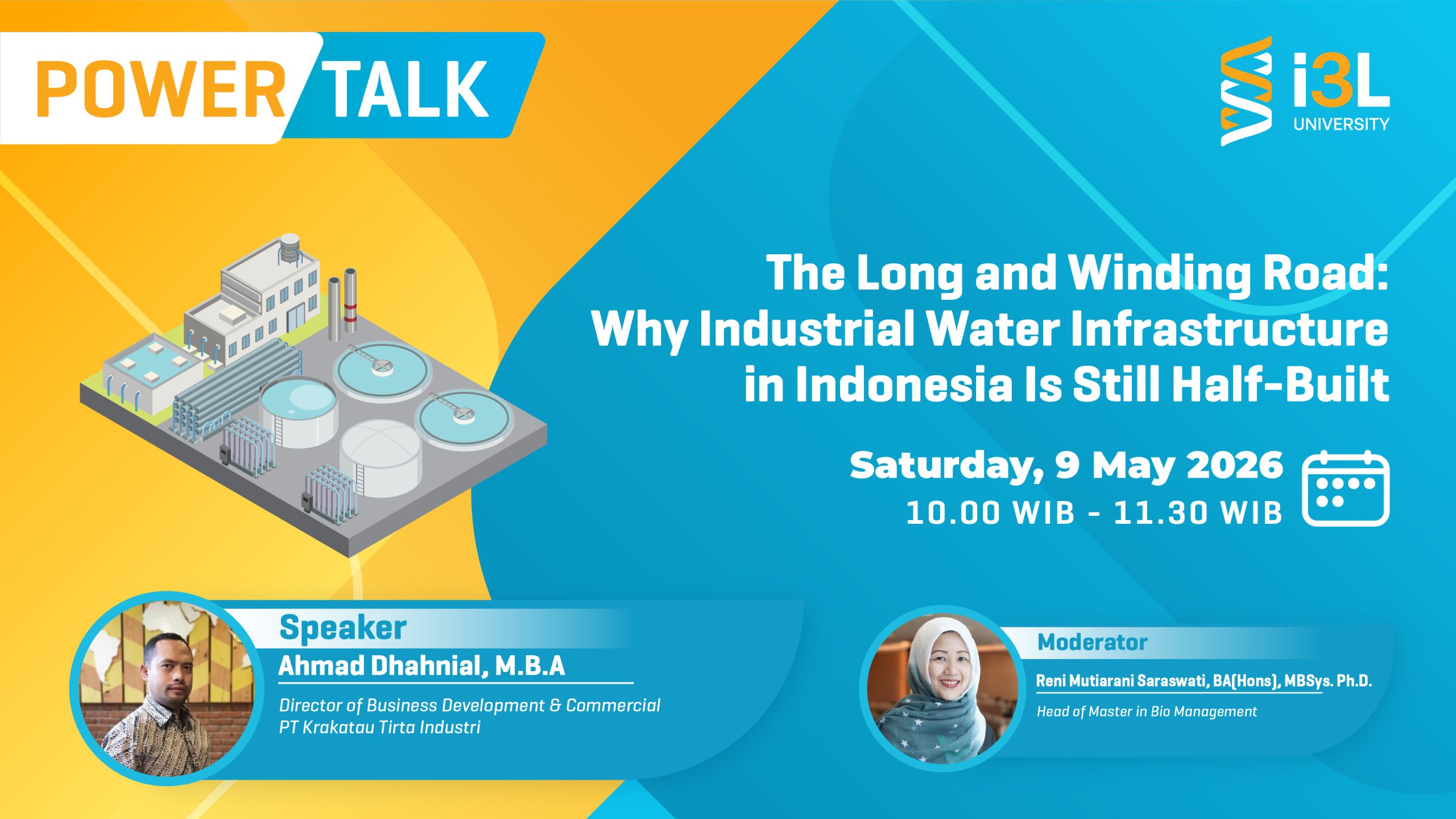
Jakarta, 12 May 2026 – On Saturday, 9 May 2026, i3L hosted an insightful webinar via Zoom featuring Mr. Ahmad Dhahnial, M.B.A., Commercial & Business Development Director of PT Krakatau Tirta Industri (KTI). The session brought together students, academics, and industry enthusiasts to discuss one of Indonesia’s most pressing yet often overlooked development challenges through the topic, “The Long and Winding Road: Why Industrial Water Infrastructure in Indonesia Is Still Half-Built.”
With professional experience spanning the energy, petrochemical, and strategic infrastructure sectors, Mr. Ahmad Dhahnial offered participants a comprehensive perspective on the realities behind Indonesia’s industrial water development. Having held strategic roles in globally recognized companies such as Petronas, ExxonMobil, Mubadala Energy, and Chandra Asri, he shared valuable insights shaped by years of involvement in business development, organizational transformation, and infrastructure planning.
The discussion highlighted the critical role industrial water infrastructure plays in supporting national economic growth. Far beyond pipelines and water treatment facilities, industrial water systems serve as the backbone of manufacturing operations, industrial estates, energy production, and urban expansion. Despite Indonesia’s rapid industrialization, however, the country continues to face significant infrastructure gaps that hinder long-term industrial competitiveness.
One of the central themes of the webinar focused on the complex challenges surrounding infrastructure development in Indonesia. The issue, as explained during the session, extends beyond technical construction and financing. Long-term planning, investment readiness, regulatory, land development alignment, and stakeholder coordination remain major obstacles in accelerating infrastructure projects. Regulatory challenges, in particular, were highlighted as an important factor affecting the pace of development, as policies and administrative processes often create uncertainty for investors and project developers.
The session also explored how industrial utility providers are being pushed to adapt to changing economic and environmental demands. As industries increasingly prioritize sustainability and operational efficiency, infrastructure systems are expected to become more resilient, integrated, and environmentally responsible. Sustainable water management is no longer viewed as an optional initiative, but rather as an essential component of future industrial growth.
Drawing from his experience at PT Krakatau Tirta Industri, Mr. Ahmad Dhahnial emphasized the importance of strategic partnerships between government institutions, private industries, and infrastructure providers. Building sustainable industrial ecosystems requires collaboration across sectors, particularly in balancing industrial expansion with environmental responsibility and long-term resource management.
The webinar concluded with an engaging discussion and Q&A session, where participants raised questions regarding Indonesia’s sustainability challenges, industrial outlook, and the future of infrastructure development. The interactive exchange reflected the growing interest among students and young professionals in understanding the intersection between industry growth, sustainability, and national development.
Through this webinar, i3L once again demonstrated its commitment to connecting academic learning with real-world industry perspectives. By inviting experienced professionals to share practical insights and current industry challenges, i3L continues to create meaningful learning opportunities that prepare students to become future leaders and innovators.
More than a discussion on infrastructure, the webinar served as a reminder that national development is shaped by long-term vision, collaboration, and resilience. As Indonesia continues its journey toward industrial advancement, discussions like these remain essential in encouraging broader understanding of the opportunities and challenges that will define the country’s future.

The Master in BioManagement is a specialized program combining life science knowledge with business management skills .
It equips graduates for high-demand careers in the growing life science sector, including: