
SMA Narada Business Ideation and Creation Workshop: Three Days from Idea to Pitch
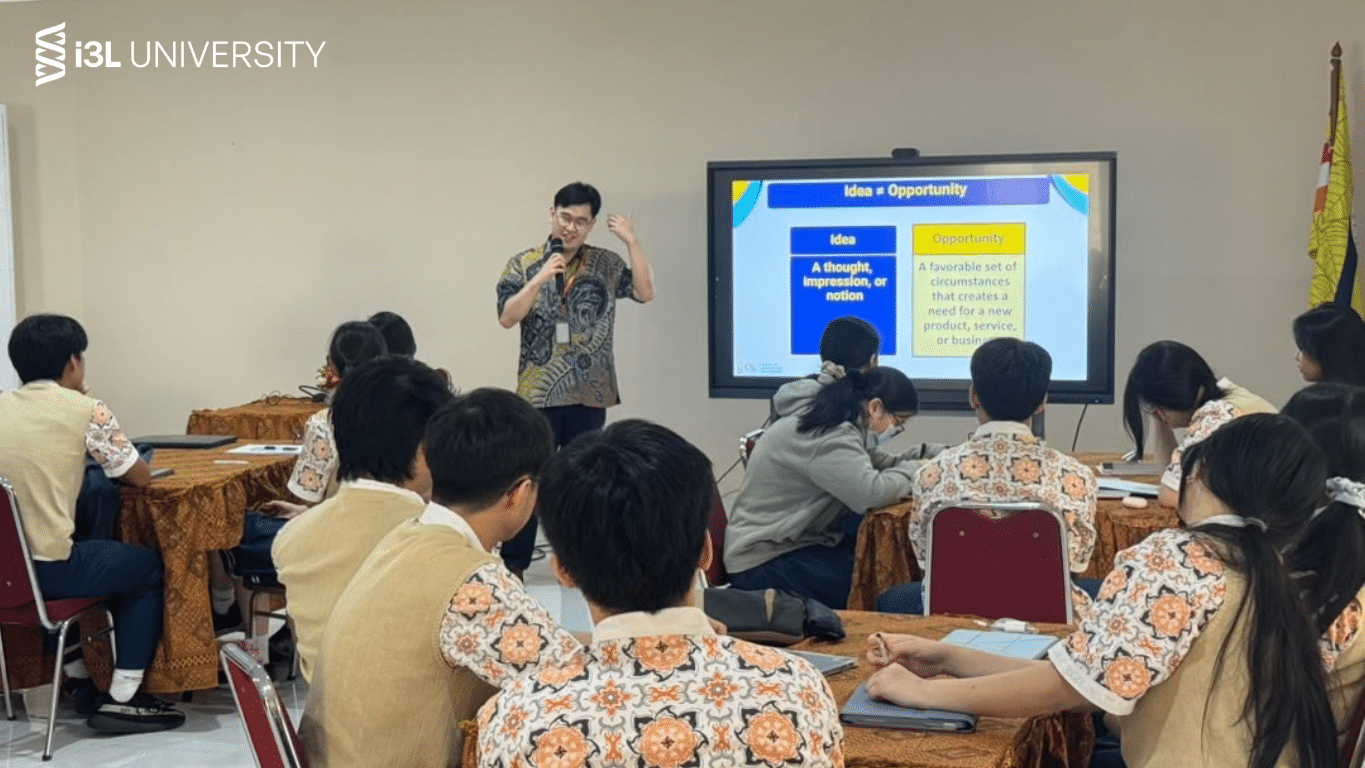
Jakarta, 25 November 2026 – From November 4 to 6, 2026, i3L University’s School of Business and Management partnered with SMA Narada to deliver a fully immersive three-day Business Ideation and Creation Workshop for grade 12 students. The first two days were held at SMA Narada’s campus, bringing the learning directly to students in their own environment. On the third and final day, participants traveled to i3L University’s campus, where they presented their completed business plans in a formal culminating session.
This workshop was not a lecture series or a passive seminar. It was a structured, progressive learning experience designed to take students from recognizing an opportunity in the world around them to standing before an audience and presenting a thought-through, prototyped business concept. Each day built on the last, moving students through the essential stages of entrepreneurial thinking: observation, ideation, strategy, creation, and communication.
For grade 12 students at a crossroads between high school and their next chapter, whether university, work, or something they have not yet imagined, this workshop offered something genuinely valuable: a first real taste of what it feels like to build something from nothing, guided by experienced facilitators and grounded in practical entrepreneurial frameworks.
The workshop opened on November 4 at SMA Narada with a focus on one of the most foundational entrepreneurial skills: spotting opportunities. Students were guided through frameworks that trained them to look at their own daily lives, their school environment, their communities, and the broader world through a different lens, one that sees unmet needs, overlooked frustrations, and unexplored possibilities where others see only the ordinary.
This first phase challenged students to move beyond passive observation toward active inquiry. What problems do people around you struggle with that no one has adequately solved? What service does your neighborhood or school community need but cannot easily access? What could be made simpler, faster, more affordable, or more enjoyable? These questions grounded opportunity recognition in real, familiar contexts, making the concept immediately relevant rather than abstract.
Building on that foundation, the second day introduced students to more advanced marketing techniques, equipping them with tools to think strategically about who their business idea would serve, how it would reach those people, and what would make it genuinely compelling in a crowded marketplace. Topics such as target audience definition, value proposition development, and basic positioning gave students a sharper vocabulary and a more structured approach for refining the ideas they had begun to generate. By the end of day two, each student or team had moved from raw observation to a business concept with a clearer shape, a defined customer, and an emerging sense of how it could stand out.
One of the most distinctive and demanding elements of the SMA Narada workshop was the prototyping phase, the stage where students moved from thinking and planning into making. Prototyping is a critical discipline in entrepreneurship because it forces an idea out of the abstract and into a form that can be evaluated, tested, and improved. It is the moment an entrepreneur discovers whether their concept holds up when it meets reality.
For high school students encountering this process for the first time, prototyping can be both exhilarating and humbling. The act of actually building a representation of their business idea, whether a mock product, a service walkthrough, a visual model, or a simple demonstration of how their concept would work in practice, demands a level of commitment and specificity that brainstorming alone does not require. It compels students to answer questions they might otherwise have deferred: How exactly does this work? What does the customer actually experience? What materials, processes, or systems are needed to deliver on the promise?
By working through these questions in a supported workshop environment, students developed a more grounded, realistic, and ultimately more persuasive understanding of their own ideas. The prototype also gave them something tangible to anchor their final presentation, turning what might otherwise have been a theoretical proposal into a demonstrated concept with visible evidence of thoughtful development.
The third and final day of the workshop, held on November 6 at i3L University’s campus, was the moment all three days had been building toward. Students arrived at the university not as tour visitors but as participants in a formal business plan presentation session, designed to mirror, in an accessible and encouraging way, the kind of real-world pitching entrepreneurs face when presenting their ideas to potential investors, partners, or customers.
Presenting a business plan sits at the intersection of analytical thinking and confident communication. It requires students to synthesize everything they have learned and developed over the previous two days into a coherent, compelling narrative: here is the problem, here is our solution, here is who it serves, here is how it works, and here is why it is worth building. For Grade 12 students, many of whom have rarely been asked to defend an original idea in front of an audience, this experience is formative in a way that extends far beyond the content of entrepreneurship itself.
Holding the final presentation at i3L University was a deliberate and meaningful choice. It gave students a first encounter with a university campus in the context of achievement rather than aspiration, reinforcing the connection between the academic environment and real creative and professional output. For some, it may well have been a preview of the kind of learning they will pursue when they continue their education at the university level.
They begin at university. By the time a student arrives in a business school classroom, the best outcome is that they already know how to think entrepreneurially, and the university deepens and refines that capacity rather than introducing it from scratch. Narada Business Ideation and Creation Workshop clearly expresses i3L University’s School of Business and Management belief that entrepreneurship education should not begin at university. By the time a student arrives in a business school classroom, the best outcome is that they already know how to think entrepreneurially, and the university deepens and refines that capacity rather than introducing it from scratch.
Workshops like this one, structured across multiple days, delivered both in students’ own schools and on the university campus, and designed to take participants all the way through the entrepreneurial process from observation to presentation, represent a high-quality, high-impact model for secondary school entrepreneurship education. They treat high school students as capable, creative young thinkers rather than passive recipients of information, and they leave participants with a genuinely expanded sense of what they can conceive and build.

Innovate. Build. Impact.
Join the Innovation and Entrepreneurship Program at i3L, where you learn by doing. From day one, you’ll work on real projects—developing business ideas, designing prototypes, and testing solutions that address real-world challenges in life sciences and beyond.
Through incubation programs, mentorship from industry experts, and collaboration with startups and research centers, you’ll gain the skills and experience to turn innovative ideas into sustainable ventures.
Graduate not just with a degree, but with a portfolio of projects and a startup-ready mindset. At i3L, you don’t just study innovation—you practice it.