

Human Capital in Business Strategy: Understanding Its Role in Organizational Performance

Jakarta, 17 April 2026 – Many organizations invest heavily in strategy, technology, and operations, yet still struggle to achieve the outcomes they expect. In many cases, the problem is not the strategy itself, but the people responsible for putting it into action.
A business plan may be well designed, operational systems may be efficient, and technology may be modern, but without the right workforce, execution often falls short.
This is why organizational performance is shaped not only by systems and processes, but also by how effectively human capital is understood, developed, and managed.
Human capital refers to the knowledge, skills, experience, judgment, and capabilities embedded in individuals that allow them to create value for an organization.
In a business setting, human capital is reflected in the ability of employees to solve problems, adapt to change, make sound decisions, collaborate effectively, and contribute to strategic goals. It is not limited to formal qualifications or job titles. It also includes the practical and behavioral qualities that influence how work is performed and how results are achieved.
It is important to separate human capital from simple headcount. A company may employ many people, but a large workforce does not automatically lead to strong performance.
What matters more is whether employees have the right capabilities, whether those capabilities match the needs of the business, and whether the organization can use and develop them effectively.
In other words, the value of people cannot be measured by numbers alone. It must be understood through the quality of their contribution to business outcomes.
For this reason, human capital should be viewed as a strategic asset rather than merely a resource.
Resources are often treated as inputs to be managed and controlled, while assets are developed and strengthened over time to generate long-term value. Human capital belongs in the second category.
When organizations invest in learning, leadership development, performance improvement, and employee engagement, they are not simply supporting daily operations. They are building capacity that can improve resilience, strengthen execution, and support sustainable growth.
This perspective also helps clarify the difference between human resources and human capital. Human resources usually refers to the administrative and functional side of workforce management, including recruitment, payroll, attendance, compliance, and employee records.
These responsibilities are essential, but they are mainly concerned with managing employment processes efficiently.
Human capital, by contrast, focuses on the value employees bring to the organization and how that value can be strengthened.
While human resources manages the employment system, human capital represents the business value generated through people.
Organizations that understand this difference are more likely to move beyond administrative HR and treat people as an important source of performance.
Human capital plays a much larger role in business strategy than many organizations assume. Strategy may define the direction of the business, but people determine whether that direction can actually be followed.
Growth plans, digital transformation, service improvement, innovation, and market expansion all depend on workforce capability. Without the right talent, leadership, and organizational readiness, even a well-designed strategy may remain strong in theory but weak in practice.
This is why human capital should be treated as a strategic asset, not just an operational support function. It shapes how well an organization adapts to change, responds to challenges, and maintains performance over time.
Investments in systems, processes, and capital only create real business value when employees are capable of using them effectively. For that reason, human capital should be integrated into business strategy from the start rather than managed separately from it.
The connection between human capital and organizational performance is also clear. Performance is often measured through profitability, productivity, efficiency, customer satisfaction, and competitiveness, but all of these outcomes are influenced by people.
Employee capability affects how well work is completed, how effectively teams collaborate, and how consistently business standards are maintained. When employees are skilled, engaged, and aligned with business priorities, organizations are more likely to perform well and sustain results over time.
Human capital is also essential for strategy execution. A strategy only becomes meaningful when it is translated into action, and that process depends on employees at every level. They are the ones who carry out priorities, solve day-to-day problems, coordinate across functions, and turn plans into results.
This requires more than clear goals. It also requires role clarity, leadership capability, accountability, and employees who have the skills needed to support organizational objectives. Without that alignment, execution often becomes inconsistent and less effective.
Beyond execution, human capital can also become a source of competitive advantage. Products, technologies, and processes can often be copied, but a workforce with strong capability, effective leadership, and a supportive culture is much harder to replicate.
Organizations that manage human capital well are often better positioned to innovate, respond to market changes, and sustain growth. Over time, this makes human capital one of the strongest links between business strategy and long-term organizational performance.
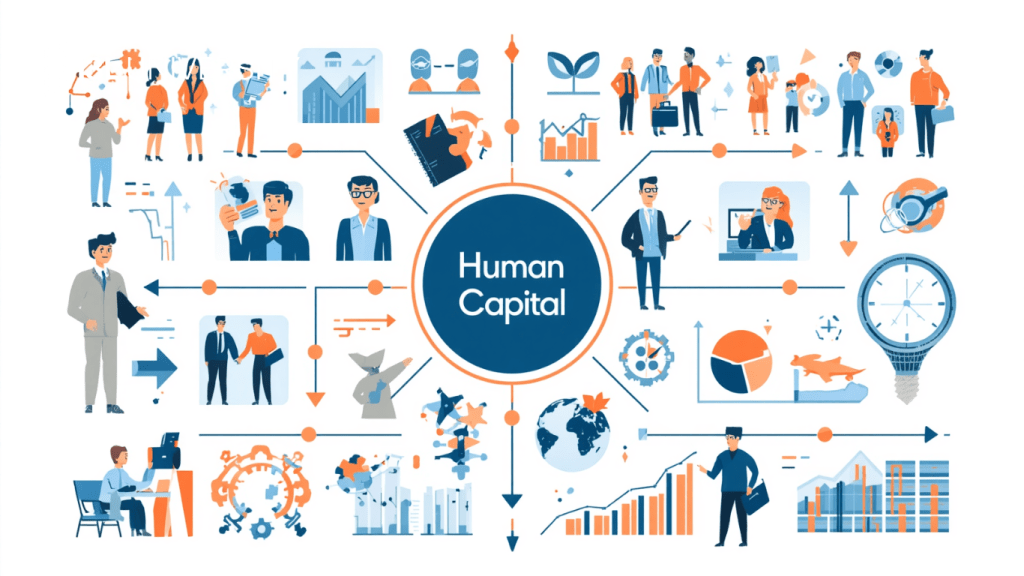
Human capital plays a much larger role in business strategy than many organizations assume. Strategy may define the direction of the business, but people determine whether that direction can actually be followed.
Growth plans, digital transformation, service improvement, innovation, and market expansion all depend on workforce capability. Without the right talent, leadership, and organizational readiness, even a well-designed strategy may remain strong in theory but weak in practice.
This is why human capital should be treated as a strategic asset, not just an operational support function. It shapes how well an organization adapts to change, responds to challenges, and maintains performance over time.
Investments in systems, processes, and capital only create real business value when employees are capable of using them effectively. For that reason, human capital should be integrated into business strategy from the start rather than managed separately from it.
The connection between human capital and organizational performance is also clear. Performance is often measured through profitability, productivity, efficiency, customer satisfaction, and competitiveness, but all of these outcomes are influenced by people.
Employee capability affects how well work is completed, how effectively teams collaborate, and how consistently business standards are maintained. When employees are skilled, engaged, and aligned with business priorities, organizations are more likely to perform well and sustain results over time.
Human capital is also essential for strategy execution. A strategy only becomes meaningful when it is translated into action, and that process depends on employees at every level. They are the ones who carry out priorities, solve day-to-day problems, coordinate across functions, and turn plans into results.
This requires more than clear goals. It also requires role clarity, leadership capability, accountability, and employees who have the skills needed to support organizational objectives. Without that alignment, execution often becomes inconsistent and less effective.
Beyond execution, human capital can also become a source of competitive advantage. Products, technologies, and processes can often be copied, but a workforce with strong capability, effective leadership, and a supportive culture is much harder to replicate.
Organizations that manage human capital well are often better positioned to innovate, respond to market changes, and sustain growth. Over time, this makes human capital one of the strongest links between business strategy and long-term organizational performance.
Although many organizations acknowledge the importance of people, far fewer manage human capital with the same discipline they apply to finance, operations, or market strategy. One common challenge is the lack of alignment between business goals and workforce capability.
Organizations may set ambitious plans for growth or transformation without first evaluating whether they have the right talent and capacity to execute them. When strategy and workforce planning move in different directions, execution becomes weaker.
Another challenge is limited visibility into workforce data. In many businesses, employee information is scattered across spreadsheets, isolated systems, and manual records. This makes it difficult for leaders to understand trends in performance, turnover, attendance, or capability development. Without clear and reliable data, talent decisions are often made with incomplete information.
Inconsistent performance evaluation also creates problems. When employees are assessed differently across teams or managers, it becomes harder to identify high performers, address gaps fairly, and make strong development decisions. At the same time, fragmented HR processes can reduce efficiency and limit strategic focus.
When payroll, attendance, recruitment, and performance management are disconnected, the organization spends more time handling administration and less time improving workforce capability.
These issues are often made worse by over-reliance on intuition rather than evidence. Judgment remains important, but workforce decisions become more effective when they are supported by data.
A strong human capital strategy begins with alignment. This means that workforce planning, talent development, and performance expectations should directly support the broader goals of the business.
If an organization aims to expand into new markets, improve innovation, or strengthen customer experience, its people strategy should reflect those priorities through targeted hiring, skill development, and leadership readiness. Human capital becomes strategic when it is not managed in isolation, but as part of the organization’s larger direction.
This alignment is important because business objectives cannot be achieved through planning alone. They require employees who understand the organization’s priorities and are equipped to contribute to them.
When people practices are clearly connected to business goals, organizations are better able to coordinate effort, build relevant capabilities, and improve execution quality across functions.
Workforce planning should not be treated as a reactive HR activity focused only on filling vacancies. In a business context, it is a strategic function that helps organizations anticipate future talent needs and prepare for change.
This includes understanding what roles will be critical, what skills may become more important, and where talent gaps could affect business performance.
Strategic workforce planning helps companies move from short-term staffing decisions to long-term capability building.
It allows leaders to prepare for expansion, restructuring, digital adoption, or leadership transitions with greater confidence. When organizations plan their workforce strategically, they reduce the risk of talent shortages and create a stronger foundation for sustainable growth.
Human capital strategy also depends on how well organizations manage performance and build capability over time. Performance management should not only measure outcomes, but also help employees understand expectations, receive feedback, and improve in ways that support business priorities.
When done effectively, it creates stronger accountability and helps align individual contributions with organizational goals.
At the same time, organizations need to focus on capability, not just current results. A business may perform well today but still face future challenges if it is not developing leadership, technical skills, and adaptability across the workforce. Strategic human capital management therefore includes both evaluating performance and investing in development, so the organization can remain competitive and resilient over time.
As organizations become more complex, workforce decisions need to be supported by data rather than assumptions alone. Human capital data can provide insight into productivity trends, employee engagement, absenteeism, turnover risk, development progress, and performance distribution. These insights help leaders make more informed choices about where to invest, which gaps to prioritize, and how to improve workforce effectiveness.
A data-driven approach also makes human capital management more accountable. Instead of relying only on general impressions, organizations can assess whether their talent strategies are producing measurable outcomes. This is especially important for business leaders who need to connect people-related decisions with performance results and long-term business value.
To manage human capital strategically, organizations need systems that can support consistency, visibility, and better decision-making. Manual processes and disconnected tools often limit the organization’s ability to see the full picture of its workforce.
By contrast, integrated systems can centralize employee data, streamline processes, and generate insights that support both HR and business leaders.
Technology plays an important role here because it turns human capital management into a more structured and scalable function. Instead of spending most of their time on administrative coordination, organizations can use digital systems to monitor performance, track development, manage payroll, and access workforce data more efficiently.
This makes it easier to align people strategy with business objectives and respond more quickly to organizational needs.
Mekari Talenta is an HCM platform that helps organizations manage human capital through a more integrated and structured approach.
By bringing together workforce data, performance management, attendance, payroll, and employee administration in one platform, it enables companies to reduce fragmentation and improve visibility across key people processes.
This is especially useful for growing organizations that need to connect everyday workforce management with broader business objectives.
From a strategic perspective, Mekari Talenta supports better alignment between workforce capability and organizational priorities.
Instead of relying on scattered records or manual tracking, companies can use a centralized system to monitor workforce information more accurately and make decisions based on real operational data.
This makes Mekari Talenta not only an administrative tool but also a practical enabler of more data-driven human capital management.
Workday is widely recognized as an enterprise-level HCM platform designed to support workforce planning, talent management, and people analytics at scale. It is often used by larger organizations that require broad functionality across multiple business units or regions.
Its strength lies in helping organizations connect workforce data with strategic planning and organizational performance.
In a business strategy context, Workday is valuable because it supports more advanced workforce visibility and decision-making.
Companies can use it to strengthen planning, track talent trends, and better align people initiatives with business transformation efforts. This makes it well suited for organizations with complex structures and a strong focus on enterprise-wide talent strategy.
SAP SuccessFactors is a human capital management solution that focuses on employee experience, performance, learning, and talent development within a broader enterprise environment. It is often used by organizations that want to align workforce management with larger digital transformation and business planning efforts.
Its strategic value comes from the way it supports capability building and organizational alignment.
By connecting performance, development, and workforce planning, SAP SuccessFactors helps companies manage human capital not only as an HR function, but as a long-term driver of business performance.
This makes it particularly relevant for organizations that want to strengthen talent pipelines and build a more future-ready workforce.
Oracle HCM Cloud is designed to help organizations manage the full employee lifecycle while supporting workforce planning, talent strategy, and organizational agility. It is often chosen by companies that need a scalable platform with strong capabilities in data management and enterprise integration.
In strategic human capital management, Oracle HCM Cloud can help leaders gain better workforce insight and improve alignment between people decisions and business needs.
Its value lies in enabling organizations to manage employee data more systematically while supporting planning and performance processes that are essential for long-term growth and operational efficiency.
BambooHR is often known as a more accessible HCM solution for small to mid-sized organizations that want to improve employee management without adopting overly complex enterprise systems.
It focuses on core HR functions such as employee records, time-off management, and performance support in a user-friendly environment.
Although simpler than some enterprise platforms, BambooHR still contributes to strategic human capital management by helping organizations organize workforce data and improve process consistency.
For growing businesses, this can be an important step in moving away from fragmented administration and toward a more structured people management approach that supports business performance.
Human capital is one of the most important drivers of business strategy and organizational performance. Strategy may define what a business wants to achieve, but people determine whether those goals can actually be delivered.
Knowledge, skills, judgment, and capability shape how effectively organizations execute plans, respond to change, and sustain performance over time.
Because of that, human capital should not be treated as a secondary support function. It should be aligned deliberately with business objectives and managed as a long-term source of value.
Organizations need to understand what capabilities they have, what capabilities they need, and how workforce decisions affect results.
Managing human capital effectively requires more than efficient administration. It requires a structured and data-driven approach that supports workforce planning, performance management, capability development, and better decision-making.
In the end, the success of any business strategy depends not only on the quality of the plan but also on how effectively people are managed, developed, and optimized to make that plan work.