
Seeing Beyond Student’s Grade: How MHFA Helps Lecturers Support Students
Written by: Reni M. Saraswati and Steven Hiu
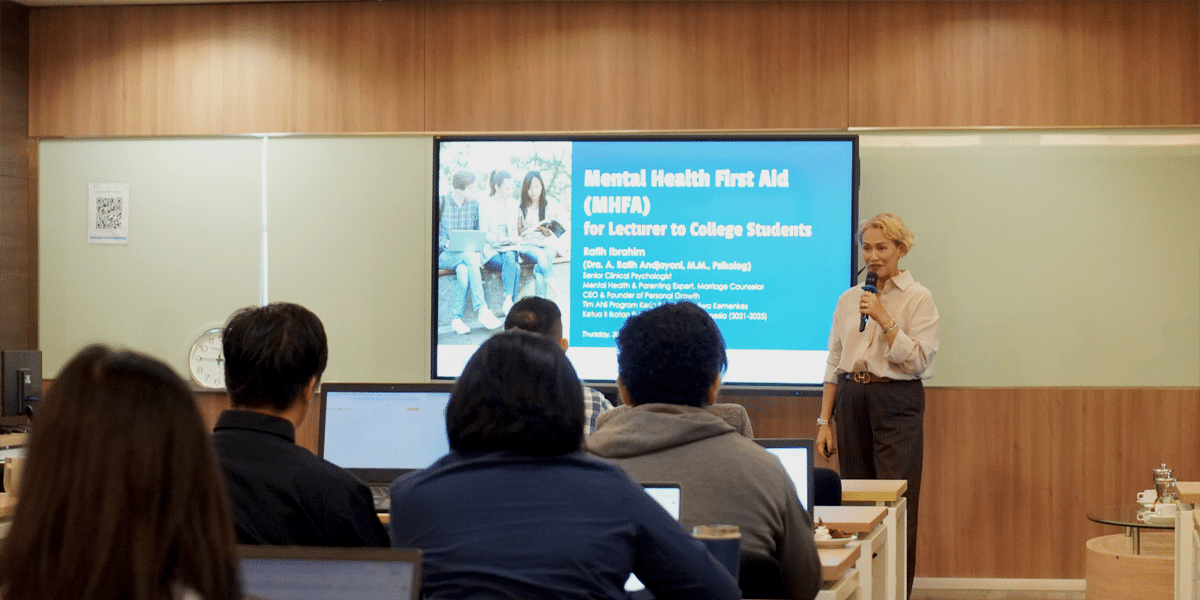
At i3L University, 36 lecturers explored how Mental Health First Aid can help educators recognize changes in student behavior, respond with empathy, and connect students with appropriate support.
JAKARTA, July 30, 2026 — The student is in class. The assignments are submitted. The grades are acceptable. On paper, everything looks fine.
But what if it isn’t?
In higher education, some of the most important signs of student distress may never appear on a grade sheet. A student may continue attending lectures while quietly losing motivation. They may submit assignments while struggling to concentrate. They may participate in class while becoming increasingly overwhelmed or withdrawing from friends.
For lecturers, this creates an important gap between what can be seen and what may actually be happening. Academic performance remains an important part of student success. But it does not always tell the whole story.
This was the focus of the Mental Health First Aid (MHFA) workshop for lecturers, held at i3L University on July 30, 2026. The workshop was designed to equip lecturers with the knowledge and practical skills to better recognize, respond to, and support students experiencing mental health and wellbeing challenges.
The session brought together 36 i3L University lecturers and was led by Dra. A. Ratih Andjayani, M.M., Psikolog, widely known as Ratih Ibrahim, CEO & Founder of Personal Growth and a Senior Clinical Psychologist with more than 30 years of professional experience.
Drawing on decades of clinical and professional experience, Ratih Ibrahim brought more than theoretical knowledge to the classroom. Her work in clinical psychology and personal development has given her extensive experience in understanding how people respond to stress, emotional challenges, and difficult life situations.
For the lecturers at i3L, this expertise provided a valuable professional perspective on a question that can be difficult to answer:
What can an educator do when they notice that a student may be struggling?
The question is particularly relevant in a university setting, where lecturers may be among the first people to notice a change in a student’s behavior, engagement, or overall functioning. A student may not directly ask for help, and the signs of difficulty may be subtle. In these moments, knowing how to respond with empathy—without making assumptions or overstepping professional boundaries—can make an important difference.
Rather than asking lecturers to become counselors or psychologists, the workshop focused on something more practical:
how to notice, how to respond, and how to know when a student may need further support.
University life is about far more than lectures, assignments, and examinations. Students are also navigating friendships and relationships, family responsibilities, career decisions, and the unfamiliar demands of greater independence. Much of that experience, however, remains outside the classroom—and outside the view of their lecturers.
Not every struggle is visible.
A student who once spoke up in class may suddenly grow quiet. Someone who was consistently engaged may begin missing deadlines or putting off assignments. Another may seem distracted, withdrawn, or simply not quite themselves.
None of these changes necessarily signals a mental health condition. They may be the result of academic pressure, personal circumstances, temporary stress, or any number of challenges. But they can be a reason to pause and pay attention.
For lecturers, that is where the challenge begins.
Lecturers are not psychologists, nor are they expected to diagnose their students. But because they see students regularly, they may be among the first to notice when something has changed.
The harder question is what to do next.
Should they ask? What should they say? How much should they listen? And when is it time to encourage a student to seek professional help?
These are not always easy questions to answer. A lecturer’s response can influence whether a student feels comfortable enough to open up, particularly when they are already feeling vulnerable. The aim is not to have all the answers, but to respond with empathy, avoid judgment, and recognize when further support may be needed.
Ratih Ibrahim addressed these questions through practical examples drawn from her decades of professional experience, showing lecturers how a simple conversation can begin with understanding rather than assumption.
Her message was straightforward: start with the person, not the problem.
That shift—from judgment to curiosity, from assumption to understanding—can change the way a difficult conversation begins. The lecturer does not need to have an immediate solution. What matters first is creating enough comfort and trust for the student to feel heard.
Through real-life examples from her professional experience, Ratih Ibrahim showed how a thoughtful approach can make a difficult conversation feel less intimidating and more supportive.
Recognizing that something has changed is only the first step. The next is knowing how to respond—how to turn that moment of concern into a conversation that is supportive, respectful, and appropriate to the lecturer’s role.
This is where the workshop’s 5A approach comes in, offering lecturers a practical way to move from noticing a concern to taking the right next step.
This framework gives lecturers a practical way to respond when they notice a student may be struggling.
For lecturers, the instinct to solve a problem is often natural. A missed assignment can be discussed, a difficult subject can be explained, and a study schedule can be adjusted. But when the problem is personal, there may be no quick fix.
A student who is struggling may not be looking for an answer at all. They may simply need someone willing to listen—without judgment, without rushing to conclusions, and without immediately trying to make everything better.
This became a recurring theme during the workshop, as lecturers raised questions about how to respond when students bring personal or emotional difficulties into the classroom. The discussion highlighted an important distinction: support does not always mean solving.
Not every lesson in the workshop came through conversation. At one point, the lecturers were asked to pause, slow down, and simply breathe.
Through a guided deep-breathing exercise, participants experienced firsthand how slowing the breath can create a moment of calm when the mind feels overwhelmed. The exercise was simple, but it offered a practical reminder that stress is not only something we talk about. It is something we experience in both the mind and body.
The exercise was well received by the participants, who found it helpful as a simple way to relax and reset. For lecturers who spend much of their time moving between lectures, administrative responsibilities, and student concerns, the brief pause also demonstrated the value of creating space to step back from the pace of the day.
Experiencing the technique themselves gave the lecturers a practical perspective they could carry into conversations with students who may be dealing with stress or emotional difficulties. It also reinforced an important point from the workshop: supporting wellbeing does not always begin with a complicated intervention. Sometimes, it can begin with helping someone slow down, feel more settled, and recognize what they are experiencing.
One of the most important lessons of MHFA is knowing what lecturers can do—and what they should leave to trained professionals.
Lecturers do not need to diagnose a student’s condition. They do not need to become therapists. And they do not need to solve every problem a student brings to them. Their role can begin with something much simpler:
Notice. Listen. Support. Connect.
When a student’s difficulties begin to significantly affect daily functioning, persist over time, or involve concerns about self-harm or harm to others, professional support becomes especially important. Knowing when to connect a student to the appropriate resources is therefore just as important as knowing how to listen.

Grades will always be part of how universities understand student progress. But they are not the whole picture. Behind every grade is a student navigating classes, expectations, relationships, pressures, and life beyond campus.
That is why awareness matters. The MHFA workshop offered lecturers a different way of looking at student success—not by changing academic standards, but by recognizing that wellbeing can shape a student’s ability to meet them. A student who appears to be doing well on paper may still be facing challenges that are not immediately visible.
For i3L University, this perspective forms part of a broader effort to create a campus environment where academic achievement and student wellbeing go hand in hand. The workshop was one step toward strengthening that environment by encouraging greater awareness among the people who interact
with students every day.
A student’s mental health is part of the journey. It shapes how they learn, grow, connect, and find their way forward.

#MentalHealthAwareness #MentalHealthFirstAid #MentalHealth #StudentWellbeing #StudentMentalHealth #HigherEducation #Education #Lecturer #Dosen #CampusWellbeing
#PsychologicalSafety #Wellbeing #HealthyCampus #EducationMatters

i3L University, formerly known as Indonesia International Institute for Life Sciences, offers interdisciplinary life sciences and business programs with global faculty, research, and innovation.
i3L University offers seven undergraduate programs: Biomedicine, Biotechnology, Pharmacy, Food Technology, Food Science & Nutrition, International Business Management, and Innovation & Entrepreneurship, and one master’s program of Master’s in Biomanagement.