
Think Green, Lead Change: ESG and Environmental Responsibility in Modern Business
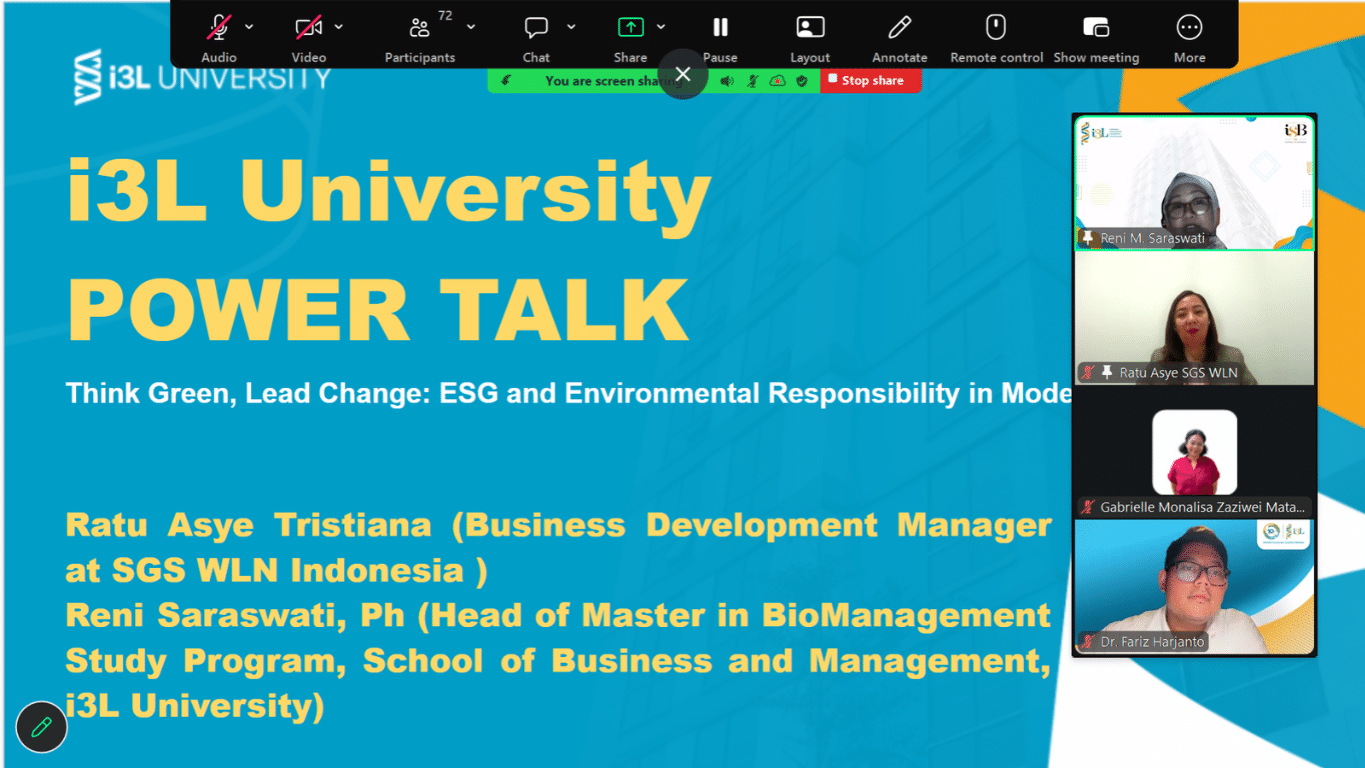
Jakarta, 16 November 2026 – On Tuesday, November 10, 2026, from 18.30 to 20.00, i3L University hosted a Power Talk session via Zoom titled “Think Green, Lead Change: ESG and Environmental Responsibility in Modern Business.” The session brought together students, faculty, and business-minded participants to explore one of the most consequential shifts in the global corporate landscape: the growing imperative for businesses to operate not just profitably, but responsibly.
In an era where climate change, social inequality, and governance failures are no longer distant risks but present-day business realities, the conversation around Environmental, Social, and Governance (ESG) principles has moved from the margins of corporate strategy to its very core. This Power Talk offered participants a timely, accessible, and expert-guided entry point into understanding what ESG means, why it matters, and how tomorrow’s business leaders can champion it in their own careers and organizations.
For students studying business, entrepreneurship, or life sciences who are asking how their future professional choices can contribute to a better world, this session provided both the intellectual framework and the practical inspiration to begin thinking and leading differently.
ESG stands for Environmental, Social, and Governance, three interconnected pillars that together define the non-financial dimensions of a company’s performance and impact. While the term is increasingly common in boardrooms, investor reports, and business school curricula, its meaning and practical implications are often misunderstood or oversimplified.
The environmental pillar addresses how a company interacts with the natural world: its carbon emissions, energy consumption, water usage, waste management practices, and overall ecological footprint. As governments tighten environmental regulations and consumers grow more conscious of the environmental cost of the products they buy, a company’s environmental profile has become a material factor in its long-term viability.
The social pillar covers how a business manages its relationships with employees, suppliers, customers, and the communities where it operates. This includes labor practices, diversity and inclusion, human rights in the supply chain, community investment, and data privacy. The governance pillar, meanwhile, concerns the internal structures and processes that guide a company’s decision-making: board composition, executive accountability, transparency, anti-corruption policies, and shareholder rights.
Together, these three pillars form a framework that allows investors, regulators, and the public to assess whether a company is being managed in a way that is sustainable, ethical, and accountable, criteria that are increasingly shaping access to capital, talent, and markets around the world.
For much of the twentieth century, the dominant model of corporate success was straightforward: maximize shareholder returns, minimize costs, and grow revenue. Social and environmental considerations were largely treated as external constraints or, at best, as public relations investments. The idea that a business should be accountable for its broader impact on society and the planet was considered idealistic at best and economically naive at worst.
That consensus has fundamentally changed. This Powertalk session examined how modern businesses are increasingly measured not only by their financial performance but also by their contribution to, or detraction from, the systems on which all economic activity ultimately depends: stable ecosystems, healthy communities, and trustworthy institutions. This shift stems from a convergence of forces, including climate science, investor pressure, regulatory change, consumer behavior, and a generational transformation in what employees and customers expect from the companies they work for and buy from.
In practical terms, this means that businesses today must integrate sustainability into their core strategy rather than treating it as a corporate social responsibility add-on. Companies that do so increasingly find that responsible business practices are not at odds with profitability but, in many cases, a source of competitive advantage, cost savings, risk reduction, and brand differentiation. The question for today’s business students and emerging leaders is not whether ESG will shape their future workplaces, but how well prepared they are to navigate and lead within that reality.
One of the central messages of the Think Green, Lead Change Power Talk was directed explicitly at students and young professionals: the responsibility for driving ESG-aligned business practices does not rest solely with CEOs, board members, or policymakers. It begins with the choices, voices, and values of the next generation of business leaders, many of whom are sitting in university classrooms today.
This framing is both empowering and demanding. It acknowledges that structural change in how businesses operate requires leadership at every level, from the graduate who advocates for sustainability metrics in a company’s reporting to the entrepreneur who builds an enterprise with ESG principles embedded from day one. Future leaders who understand ESG are better positioned to ask the right questions in job interviews, propose meaningful changes in the organizations they join, attract ESG-conscious investors when they launch ventures, and build cultures that treat environmental and social accountability as a professional norm rather than an optional virtue.
For i3L University students across both the School of Business and Management and the School of Health and Life Sciences, the intersection of ESG and professional responsibility carries particular weight. Many life sciences industries, including pharmaceuticals, food production, biotechnology, and healthcare, face intense scrutiny over their environmental footprints and social impacts. Graduates who can bridge scientific literacy with ESG strategic thinking are exceptionally well equipped to lead responsibly in these sectors.
A key insight explored throughout the Power Talk was that ESG integration, when done genuinely and strategically, is not a cost center but a value creator. This perspective challenges the outdated assumption that responsible business practices necessarily come at the expense of financial performance. The evidence from global markets increasingly tells a different story.
Companies with strong ESG profiles tend to attract more stable, long-term institutional investors, particularly as environmental, social, and governance criteria become standard components of investment analysis. They also face lower regulatory risk as governments across ASEAN and globally tighten sustainability disclosure requirements and carbon pricing mechanisms. Strong ESG governance reduces reputational risk and builds brand equity that translates into customer loyalty. A genuine commitment to social responsibility, including fair labor practices and community investment, strengthens employee engagement and retention in a talent market where purpose-driven work is increasingly valued.
Beyond the organizational level, the broader case for ESG is even more compelling. Businesses that embed environmental responsibility into their operations contribute to healthier ecosystems, cleaner air and water, and more resilient communities. At scale, this means that the aggregate choices of thousands of companies can meaningfully shift the trajectory of climate change, social inequality, and institutional trust.

The School of Business and Management (SBM) at i3L University offers a distinctive business education where entrepreneurial thinking meets life sciences innovation. With two undergraduate programs, International Business Management and Innovation and Entrepreneurship, SBM prepares students to lead at the intersection of global commerce, technology, and science. Through international partnerships, real-world industry exposure, and a globally connected faculty, SBM equips graduates with the strategic mindset, cross-cultural intelligence, and practical experience needed to thrive in an interconnected world.