

Undergraduate Programs:
School of Health and Life Sciences
School of Business and Management
Postgraduate Program:
Professional Program:
Pharmacist Professional (Apoteker)
Descriptive Sensory Analysis in Cosmetic Testing: Penalty Analysis
Written by: Lydia Kurniadi & Anisa Nurjanah
Jakarta, 06 March 2026 – Sensory analysis, or sensory evaluation, is a crucial step for brands before launching their products. Typically, sensory analysis is conducted during the product development stage or as a closing step before a product launch. In cosmetic product development, sensory analysis is not only used to measure product characteristics but also to identify specific relationships between product characteristics and consumer perceptions. Several product parameters, such as stickiness, spreadability, absorption, and aroma intensity, can be determining factors in a product’s acceptance.
Descriptive sensory analysis indicates the strength of a product’s characteristics. However, to determine whether these levels are “just right” for consumers, a penalty analysis method is used.
Penalty Analysis is a test that measures a product’s strengths and weaknesses by assessing each parameter using the Just-About-Right (JAR) and Hedonic scales. The Just-About-Right (JAR) scale is used to assess whether a product characteristic is at the right level or needs improvement or reduction during product development. Typically, the JAR scale is divided into three categories: too little, just right (JAR), and too much.
Meanwhile, the Hedonic scale is used to measure overall liking. Consumers can rate their level of liking for a product characteristic using a numerical scale (e.g., 1-9, from extremely dislike to extremely like). By combining the assessments from these two scales, brands can assess whether an unsuitable characteristic is truly disliked.
Consumers will be asked to rate each product parameter, such as stickiness, spreadability, absorbency, and aroma intensity, using two scales: the JAR scale and the hedonic scale. The Just-About-Right (JAR) scale is used to assess whether a characteristic is “just right,” and the hedonic scale is used to assess overall liking. After data collection, responses on the JAR scale are grouped into three main categories: too little, just right (JAR), and too much. Next, the average overall liking score for each parameter is calculated.
By comparing the average liking score between the group that feels the attribute is “just right” and the group that feels it is “not right,” we can determine whether the discrepancy reduces liking. This is where the concept of “penalty” arises, namely, the magnitude of the decrease in liking when a characteristic is not at the consumer’s desired level.
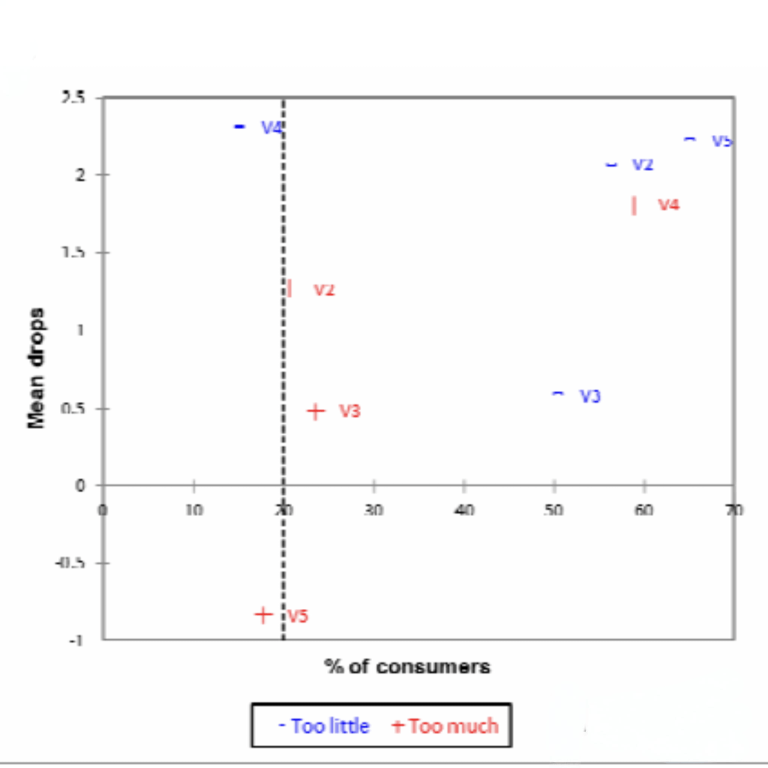
The way to read the penalty analysis graph is to look at the two main components of the assessment, namely how many consumers feel that an attribute is “inappropriate” and to what extent this can reduce the level of liking for the product. The X-axis shows the number (in %) of consumers who feel that the attribute is inappropriate (JAR) or consumers who feel that the attribute is “too much” or “too little.” This means that the further to the right, the more people feel that the attribute is not right. Meanwhile, the Y-axis shows how much the overall liking score drops (mean drop) when the attribute is not optimal. The further up, the greater the impact of the attribute assessment on consumer satisfaction with the product.
Penalty analysis has been widely applied in the food and beverage industry for many years. In that sector, it is commonly used to optimize sweetness, saltiness, flavor intensity, and texture attributes that directly influence repeat purchase. It has become a standard consumer-driven tool to guide reformulation decisions.
In contrast, its application in the cosmetic industry remains relatively limited. Cosmetic testing often emphasizes safety, stability, and efficacy, while sensory adjustments are frequently based on internal evaluation or qualitative feedback rather than structured consumer penalty modeling.
However, sensory experience plays a critical role in cosmetic acceptance. A texture that feels too sticky, an absorption time that feels too slow, or a fragrance that is too strong can significantly reduce overall liking even if the product delivers proven functional benefits.
For the R&D team, penalty analysis is a tool that can assist in decision-making about creating the best formulation that aligns with consumer acceptance data on product characteristics. While the penalty analysis method cannot provide a precise number of ingredient levels to change, it can provide clear direction as to whether a characteristic needs to be increased or decreased to better align with consumer preferences. This approach makes the reformulation process more focused and efficient, minimizing trial and error. Changes are made based on their impact on consumer satisfaction, not on technical assumptions alone.

i3L University’s Skinovation is an innovative cosmetic testing center in Indonesia that offers customizable, science-driven solutions, to help brands validate their claims with confidence.
By combining sensory studies, modern multi-probe analyzer, and cutting-edge in vitro testing, we empower cosmetic producers to strengthen product credibility and succeed in both local and global markets.
Undergraduate Programs:
School of Health and Life Sciences
School of Business and Management
Postgraduate Program:
Professional Program:
Pharmacist Professional (Apoteker)
Undergraduate Programs:
School of Life Sciences
School of Business
Postgraduate Program:
Professional Program: