

Navigating ASEAN’s Consumer Market: Bridging Academic Rigor and Real-World Execution
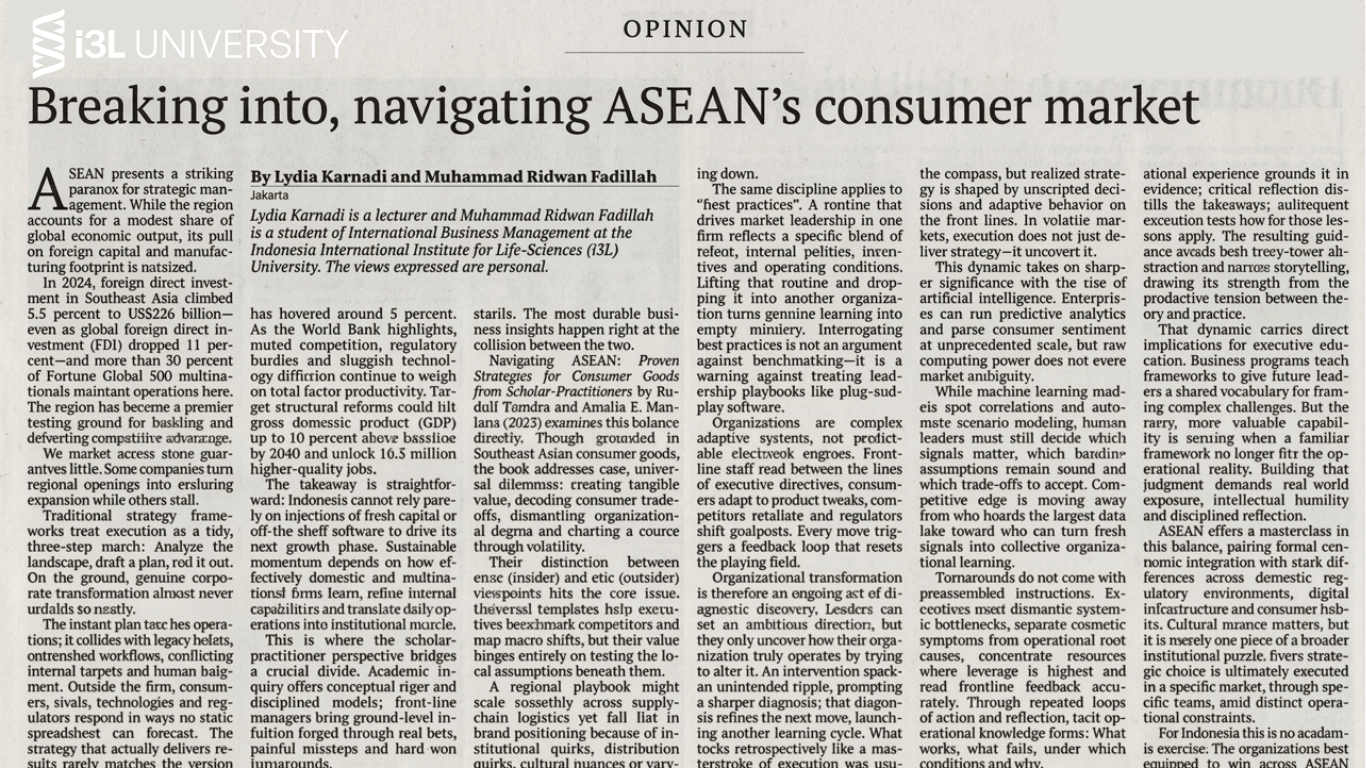
By: Lydia Karnadi, S.T., MBA and Muhammad Ridwan Fadillah
Jakarta, 07 September 2026 — ASEAN presents a striking paradox for strategic management. While the region accounts for a modest share of global economic output, its pull on foreign capital and manufacturing footprint is outsized.
In 2024, foreign direct investment in Southeast Asia climbed 8.5 percent to US$226 billion—even as global foreign direct investment (FDI) dropped 11 percent—and more than 80 percent of Fortune Global 500 multinationals maintain operations here. The region has become a premier testing ground for building and defending competitive advantage.
Yet market access alone guarantees little. Some companies turn regional openings into enduring expansion while others stall.
Traditional strategy frameworks work treat execution as a tidy, three-step march: Analyze the landscape, draft a plan, roll it out. On the ground, genuine corporate transformation almost never unfolds so neatly.
The instant plan touches operations; it collides with legacy habits, entrenched workflows, conflicting internal targets and human judgment. Outside the firm, consumers, rivals, technologies and regulators respond in ways no static spreadsheet can forecast. The strategy that actually delivers results rarely matches the version drawn up in the boardroom.
This friction is especially evident in Indonesia. The country vaulted from the world’s 29th-largest economy in 1968 to the 16th in 2024, but annual growth has hovered around 5 percent. As the World Bank highlights, muted competition, regulatory hurdles and sluggish technology diffusion continue to weigh on total factor productivity. Target structural reforms could lift gross domestic product (GDP) up to 10 percent above baseline by 2040 and unlock 16.5 million higher-quality jobs.
The takeaway is straightforward: Indonesia cannot rely purely on injections of fresh capital or off-the-shelf software to drive its next growth phase. Sustainable momentum depends on how effectively domestic and multinational firms learn, refine internal capabilities and translate daily operations into institutional muscle.
This is where the scholar-practitioner perspective bridges a crucial divide. Academic inquiry offers conceptual rigor and disciplined models; front-line managers bring ground-level intuition forged through real bets, painful missteps and hard-won turnarounds.
Neither suffices on its own. Untethered from conceptual frameworks, practical experience remains purely anecdotal; without exposure to operational friction, management theory becomes sterile. The most durable business insights happen right at the collision between the two.
Navigating ASEAN: Proven Strategies for Consumer Goods from Scholar-Practitioners by Rudolf Tjandra and Amalia E. Maulana (2025) examines this balance directly. Though grounded in Southeast Asian consumer goods, the book addresses core, universal dilemmas: creating tangible value, decoding consumer trade-offs, dismantling organizational dogma and charting a course through volatility.
Their distinction between emic (insider) and etic (outsider) viewpoints hits the core issue. Universal templates help executives benchmark competitors and map macro shifts, but their value hinges entirely on testing the local assumptions beneath them.
A regional playbook might scale smoothly across supply-chain logistics yet fall flat in brand positioning because of institutional quirks, distribution quirks, cultural nuances or varying channel maturity. The goal is never a binary choice between blanket standardization and hyper-localization; it is knowing which operational premises travel well and which need tearing down.
The same discipline applies to “best practices”. A routine that drives market leadership in one firm reflects a specific blend of talent, internal politics, incentives and operating conditions. Lifting that routine and dropping it into another organization turns genuine learning into empty mimicry. Interrogating best practices is not an argument against benchmarking—it is a warning against treating leadership playbooks like plug-and-play software.
Organizations are complex adaptive systems, not predictable clockwork engines. Frontline staff read between the lines of executive directives, consumers adapt to product tweaks, competitors retaliate and regulators shift goalposts. Every move triggers a feedback loop that resets the playing field.
Organizational transformation is therefore an ongoing act of diagnostic discovery. Leaders can set an ambitious direction, but they only uncover how their organization truly operates by trying to alter it. An intervention sparks an unintended ripple, prompting a sharper diagnosis; that diagnosis refines the next move, launching another learning cycle. What looks retrospectively like a masterstroke of execution was usually an accumulation of real-time calibrations, practical experiments and mid-course steering.
This is the essence of Henry Mintzberg’s concept of emergent strategy. Deliberate planning sets the compass, but realized strategy is shaped by unscripted decisions and adaptive behavior on the front lines. In volatile markets, execution does not just deliver strategy—it uncovers it.
This dynamic takes on sharper significance with the rise of artificial intelligence. Enterprises can run predictive analytics and parse consumer sentiment at unprecedented scale, but raw computing power does not erase market ambiguity.
While machine learning models spot correlations and automate scenario modeling, human leaders must still decide which signals matter, which baseline assumptions remain sound and which trade-offs to accept. Competitive edge is moving away from who hoards the largest data lake toward who can turn fresh signals into collective organizational learning.
Turnarounds do not come with preassembled instructions. Executives must dismantle systemic bottlenecks, separate cosmetic symptoms from operational root causes, concentrate resources where leverage is highest and read frontline feedback accurately. Through repeated loops of action and reflection, tacit operational knowledge forms: What works, what fails, under which conditions and why.
Scholar-practitioners translate this tacit knowledge into structured insight without stripping away the context that gives it value. Rigorous research provides analytical structure; operational experience grounds it in evidence; critical reflection distills the takeaways; subsequent execution tests how far those lessons apply. The resulting guidance avoids both ivory-tower abstraction and narrow storytelling, drawing its strength from the productive tension between theory and practice.
That dynamic carries direct implications for executive education. Business programs teach frameworks to give future leaders a shared vocabulary for framing complex challenges. But the rarer, more valuable capability is sensing when a familiar framework no longer fits the operational reality. Building that judgment demands real-world exposure, intellectual humility and disciplined reflection.
ASEAN offers a masterclass in this balance, pairing formal economic integration with stark differences across domestic regulatory environments, digital infrastructure and consumer habits. Cultural nuance matters, but it is merely one piece of a broader institutional puzzle. Every strategic choice is ultimately executed in a specific market, through specific teams, amid distinct operational constraints.
For Indonesia this is no academic exercise. The organizations best equipped to win across ASEAN will not be those anchored to rigid five-year plans or bloated datasets, but those agile enough to turn everyday friction into insight, and insight into decisive action.

i3L University’s International Business Management study program gives you the essential skills for global, multicultural leadership, balanced with a human-centric social science focus. Our program is structured for experience: you do an internship 8 times in 8 semesters! All coursework is condensed into the first half of Semesters 1-5. The rest is dedicated to your mini-internships. Graduate with eight professional experiences ready for your career.