
Turning Uncertainty into Strategy: Understanding Risk Management in Unpredictable Times
Jakarta, 12 March 2026 – In today’s fast-changing world, uncertainty has become an unavoidable part of decision-making. Organizations are often required to make strategic choices despite incomplete information, volatile environments, and rapidly evolving risks. Understanding how to distinguish uncertainty from risk and how to manage both effectively has therefore become an essential competency for modern leaders.
These ideas were explored during a Professional Development Series session hosted by the Master of Bio Management program at i3L University on 29 January 2026, titled “Risk Management: Bridging Risk and Uncertainty.” Conducted online via Zoom, the event brought together participants from academic and professional backgrounds who were interested in strengthening their understanding of risk assessment and strategic decision-making.
The session featured Rosita Widjojo, S.E., M.B.A., Ph.D., a faculty member in the Master of Bio Management program at i3L University and an expert in risk management and sustainable finance. Through her teaching and research, Dr. Rosita has contributed to advancing enterprise risk management education and promoting analytical frameworks that help organizations navigate complex financial and strategic challenges.
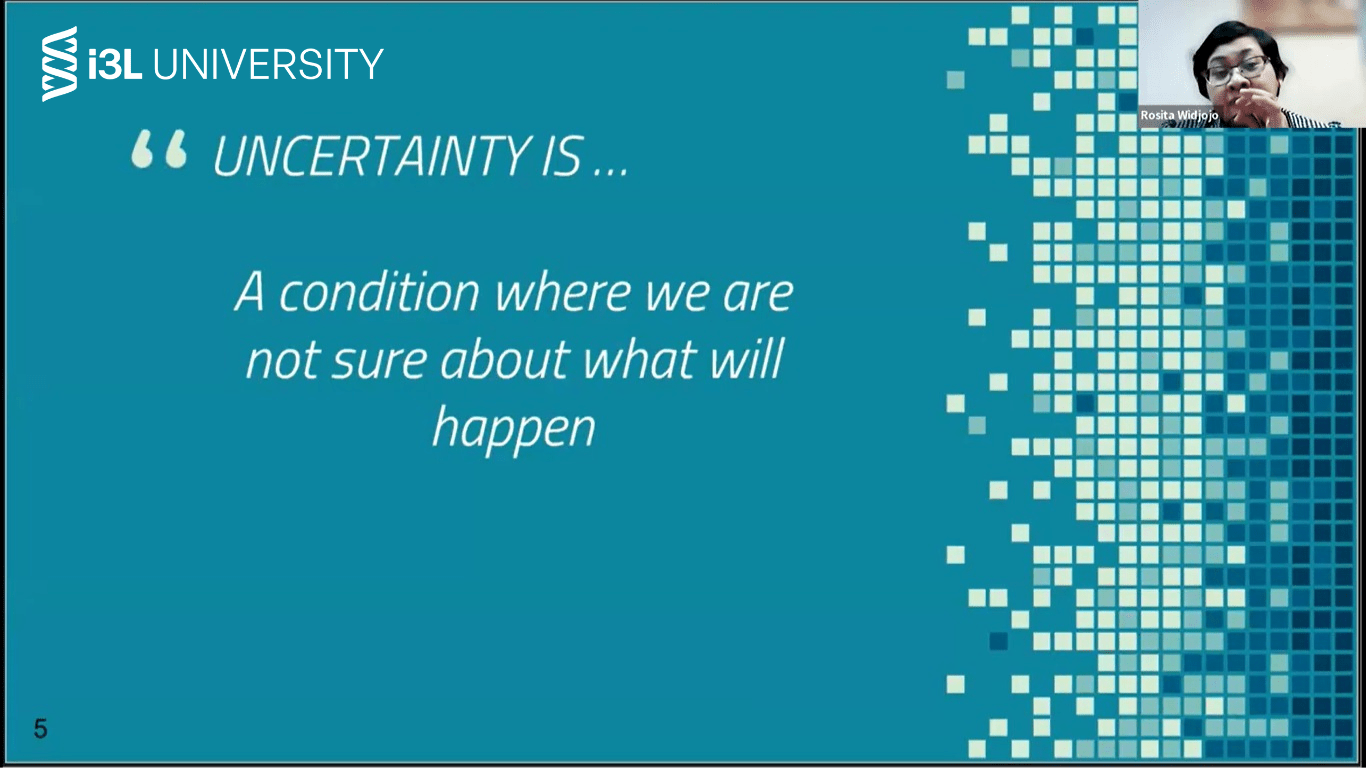
Dr. Rosita addressed a common misconception in decision-making: the tendency to treat uncertainty and risk as interchangeable concepts. She explained that uncertainty refers to situations where future outcomes remain unclear or unpredictable, while risk represents the measurable possibility that outcomes may deviate from expectations. Understanding this distinction, she noted, allows organizations to move beyond intuition and adopt more structured approaches when dealing with complex environments.
A key framework discussed was the four levels of uncertainty, which help decision-makers assess how predictable future conditions are. Some situations allow relatively confident forecasts, while others involve multiple possible scenarios or even complete ambiguity. Recognizing these levels enables organizations to select strategies better aligned with the available information.
The discussion also highlighted practical risk assessment tools, particularly the risk matrix. By evaluating two central variables, likelihood and consequence, organizations can determine the severity of potential risks and prioritize actions accordingly. This approach allows managers to allocate resources effectively and focus on the issues that pose the greatest potential impact.
Another important aspect of the discussion was Business Continuity Planning (BCP), which prepares organizations to maintain operations during unexpected disruptions. Through illustrative scenarios such as earthquakes affecting offices in coastal and mountainous regions, Dr. Rosita demonstrated how preventive controls, crisis communication strategies, and recovery planning can significantly reduce both the probability and the consequences of disruptive events.
Ultimately, effective risk management is not merely about avoiding threats it is about building resilience. By transforming uncertainty into structured analysis and informed strategy, organizations can respond more confidently to complex challenges and sustain long-term performance.
Through initiatives such as the Professional Development Series, such events continue to create opportunities for professionals and the broader community to engage with timely topics and expert insights. By bringing academic expertise into practical discussions, these sessions help participants strengthen their strategic thinking and stay prepared for the challenges of an increasingly uncertain world.
Because in a world shaped by uncertainty, informed decisions are the strongest strategy.

The Master in BioManagement is a specialized program combining life science knowledge with business management skills .
It equips graduates for high-demand careers in the growing life science sector, including: