
Science-Supported Skincare: Why Validation Matters More Than Claims
Jakarta, 23 February 2026 – Skincare claims play a crucial role in influencing consumer purchasing decisions. Claims such as brightening in 10 days, fading wrinkles in 14 days, or moisturizing all day are common in cosmetic products today to attract consumers. However, are these claims truly scientifically proven, or are they simply “written” as a marketing strategy?
As consumer awareness increases, claims without scientific evidence are no longer easily trusted. This is why science-supported skincare is increasingly important in today’s industry.
What is a Science-Supported Cosmetic?
Science-supported skincare is a product development approach based on scientific evidence and measurable data. From the initial development stage, formulas are designed using researched raw materials, then undergo a series of structured tests to ensure their safety, stability, and effectiveness. This process is not instantaneous but rather lengthy and systematic, as it is based on scientific research.
In addition to being data-driven, product development must also comply with applicable quality standards and regulations to ensure the reliability of each result. This ensures that the benefits offered are not mere baseless claims but the result of a product validation process involving laboratory testing and clinical trials.
Why Validation Matters More Than Claims?
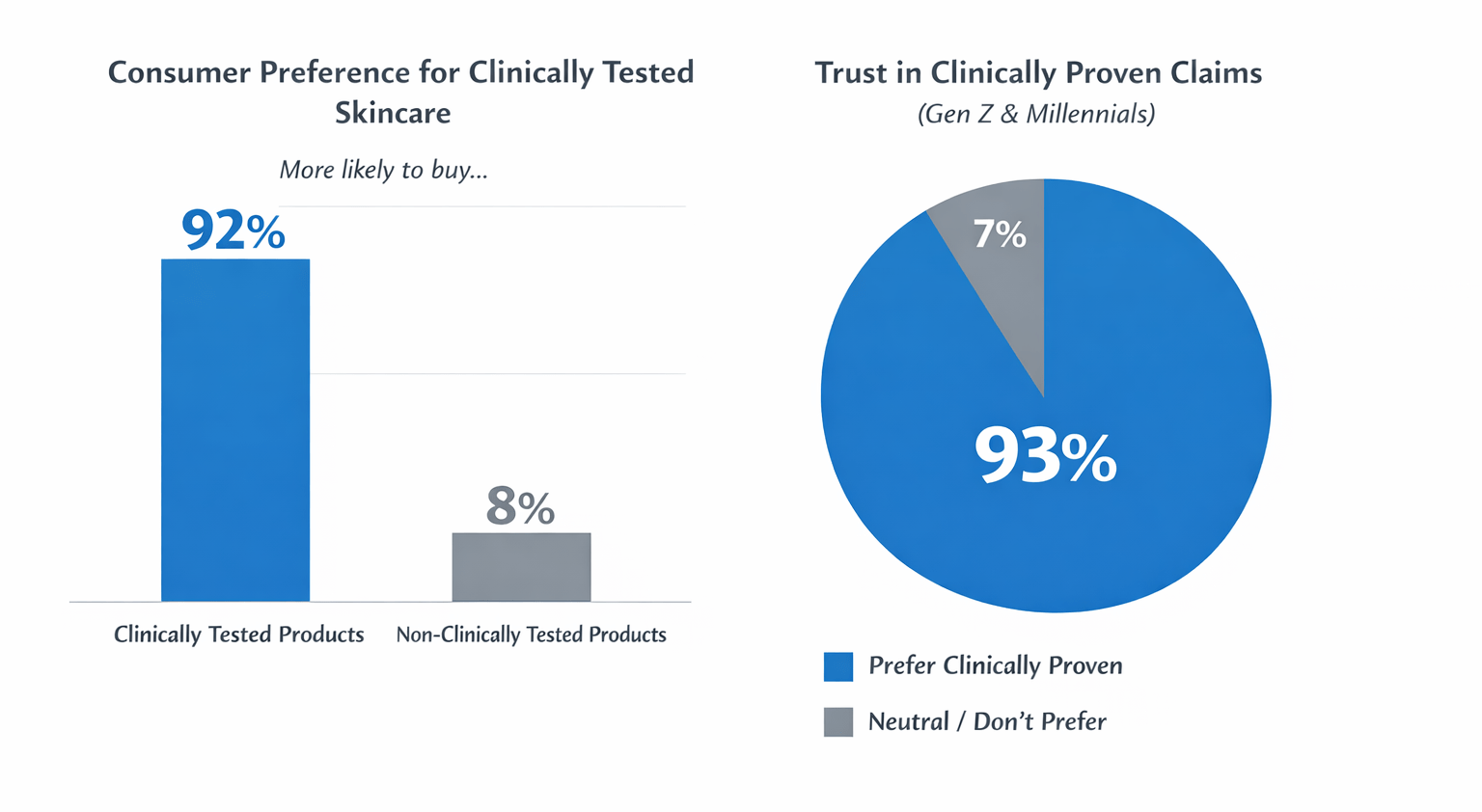
In the competitive skincare industry, consumers are increasingly selective in their product choices. A survey of 1,000 consumers by Citruslabs found that 92% preferred products that had been clinically tested. Among generational groups, Citruslabs found that 91% of Gen Z consumers trust product claims supported by research. This demonstrates that consumer trust and purchasing decisions are not based solely on advertising claims but require concrete evidence.
Additionally, scientifically verified skincare products can help brands minimize legal and reputational risks arising from inaccurate and misleading claims that could harm consumers. With the support of real, tested data, brands can build consumer trust and, ultimately, strengthen their product’s competitive edge.
Validation as Part of the Process, Not the Final Stage
Scientific validation involves collaboration between the R&D team, testing laboratories, and quality and regulatory teams to ensure that every claim is supported by accountable data. This process should begin during the formula development stage, continue prior to launch, and be repeated in the event of reformulation or market expansion. Thus, validation is not merely a formality at the end of production, but rather a strategic part of the overall product innovation cycle.
In practice, different types of testing are used at different stages, and each serves a distinct purpose. Some explain how an ingredient works at a biological level, others measure real performance on human skin, while some evaluate user experience and market acceptance.
One of the earliest stages is in vitro testing, conducted in laboratories using cells, enzymes, or reconstructed skin models. This stage helps demonstrate the mechanism of action of an ingredient. For example, a brightening product may be tested for its ability to inhibit tyrosinase activity, while an anti-aging ingredient may be evaluated for its potential to stimulate collagen production in fibroblast cells. Claims such as “supports collagen production at the cellular level” or “helps inhibit melanin formation” are typically supported by this type of data. However, in vitro results mainly explain how an ingredient works, not yet how the final product performs on real skin.
After the formula is finalized, validation continues with in vivo or clinical testing, which involves human volunteers under controlled conditions. This stage measures observable skin changes such as hydration, elasticity, wrinkle depth, or pigmentation over a defined period. Claims like “increases skin hydration after four weeks” or “reduces wrinkle depth within 28 days” are generally supported by clinical studies. Because it reflects actual use on human skin, in vivo testing is essential for measurable and time-based claims.
Beyond performance data, sensory evaluation assesses how the product feels during application, including texture, absorption, and overall comfort. Claims such as “lightweight texture” or “non-sticky finish” often come from structured user perception studies. While subjective, these results strongly influence purchasing decisions.
Lastly, market studies evaluate consumer acceptance through surveys or home-use tests. Statements such as “most users would repurchase” are typically derived from this stage. Although this does not prove biological efficacy, it demonstrates real-world trust and product relevance.
Together, these validation methods show that evidence in skincare is layered and continuous. Validation is not added at the end to justify claims — it is embedded throughout the entire development process, ensuring that every claim made is supported by appropriate and measurable proof.

i3L University’s Skinovation is an innovative cosmetic testing center in Indonesia that offers customizable, science-driven solutions, to help brands validate their claims with confidence.
By combining sensory studies, modern multi-probe analyzer, and cutting-edge in vitro testing, we empower cosmetic producers to strengthen product credibility and succeed in both local and global markets.