
Alan Turing: The Father Of Computer Science
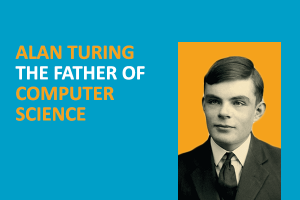
If we heard the name Alan Turing, not many of us would associate the figure of Alan Turing with computers. Most of us are already familiar with computers, whether they’re personal computers, laptops, or simply smartphones, but only a few of us know that Alan Turing made all of those possible. The idea of Alan Turing became one of the footholds for the development of modern computers. We can safely say that Alan Turing is the father of the computer.
Who is Alan Turing exactly? And how can his idea be the important foundation of computers? Let’s peek a little closer, shall we?
Born on June 23, 1912, he has the full name Alan Mathison Turing. Since the age of 15, Alan Turing has shown outstanding abilities in mathematics and science. That talent then brought Alan Turing to receive a scholarship to study at King’s College, Cambridge, England.
While studying for his bachelor’s degree, he became interested in ‘The Decision Problem,’ or in German, ‘Entscheidungsproblem.’ Alan Turing’s obsession with solving ‘The Decision Problem,’ which was a difficult mathematical problem to solve in the 20th century, was initiated by David Hilbert, a mathematician from Germany, and will make Alan Turing the Father of the Computer.
with His hypothesis: Alan Turing devised an imaginary idea about a machine that is able to read, write, and erase symbols that work according to certain rules. What the machine does is actually human work. He called people who do these activities ‘computers.’ This machine will stop once the needed answer has been solved. If the answer is never found, Alan Turing explained that the machine will not stop.
The idea of machine imagery from Alan Turing later became one of the main pillars of computer science. Moreover, this idea is one of the most influential mathematical concepts of the 20th century.
The idea known as the Turing Machine explains the limitations of mechanical computing. In addition, the Turing Machine theoretically represents a single algorithm and programming system. This concept serves as a universal description of computing performance.
The Turing machine is not a concept that can be used to create a perfect computer. However, it does explain how the basic logic of writing and reading data programs should work. The idea also explains that even a simple device must have enough memory to load its operating logic mechanically.
World War 2 ensued; Alan Turing was recruited to work at Bletchley on a secret allied project. There Alan Turing joined a group to create a code-cracking machine named Bombe.
The Bombe is a machine capable of translating messages sent by the German message scrambler, Enigma. Previously, someone needed to crack the code manually, but with Bombe, Enigma’s scrambled messages could be decoded automatically.
In 1948, Alan Turing wrote an essay entitled Intelligent Machinery. In the article, Alan Turing provides further details about the concept of the Turing Machine that he initiated.
Two years later, Alan Turing published an idea under the title Computing Machinery and Intelligence. This paper is one of the foundations of artificial intelligence.
In one article, Alan Turing suggested the concept of artificial intelligence system development. Instead of creating computers as intelligent as adults, it would be better to build computers with children’s intelligence and then teach these computers to learn on their own constantly. This thinking is in line with the concept of machine learning.